

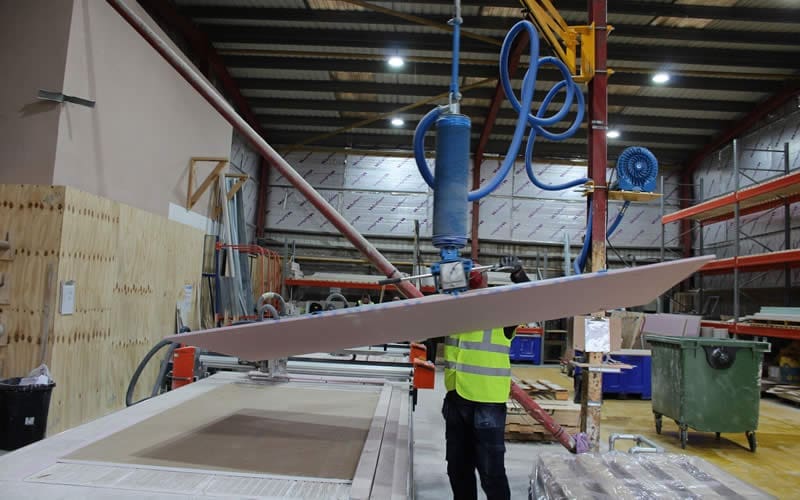
How Offsite Drywall Manufacturing Can Improve Productivity, Installed Cost and Programme Certainty
On large construction projects, small inefficiencies repeated hundreds or thousands of times can become significant costs.
Drywall is a good example.
Traditional installation can require site teams to measure, cut and fabricate substantial quantities of plasterboard components before those components can actually be installed.
For a large hotel, student accommodation development, healthcare facility, commercial office or high-rise residential project, those additional labour hours can accumulate throughout the programme.
Offsite drywall production moves suitable repetitive fabrication away from the construction site and into a controlled manufacturing environment.
Components can then arrive prepared for installation, helping contractors reduce site fabrication, make better use of skilled labour, minimise waste and create a more predictable drywall programme.
For large and repetitive projects, the question therefore isn’t simply:
“How much does the drywall component cost?”
A better question is:
“What is the total installed cost of delivering the drywall package?”
Why Offsite Drywall Works Particularly Well on Large Projects
The commercial benefits of offsite manufacturing tend to increase where projects contain substantial volumes of repeatable drywall details.
Examples include:
- Repeated hotel bedrooms.
- Student accommodation rooms.
- Apartment layouts.
- Corridors.
- Door openings.
- Builders work openings.
- Deflection heads.
- Bathroom pod interfaces.
- Standard partition details.
Instead of repeatedly fabricating these components on individual floors or work areas, suitable elements can be manufactured in batches before arriving on site.
The existing article identifies reduced programme time, lower on-site labour demand, greater predictability and improved quality control as key advantages for large-scale projects.
What Is Offsite Drywall Production?
Offsite drywall production is the manufacture of project-specific drywall and plasterboard components away from the construction site, using agreed drawings, dimensions and specifications before delivery for installation.
Rather than replacing the drywall installation itself, the process removes suitable fabrication activities from site.
Depending on the project, Drywall Pro-Cut can manufacture components including:
- Deflection heads.
- Deflection head plasterboard strips.
- Builders work openings.
- Door sets.
- Boards cut to size.
- Plywood pattresses.
- Bulkheads.
- Beam encasements.
- Column encasements.
- Window openings.
- Bathroom pod linings.
- Bespoke drywall components.
The objective is simple: manufacture repeatable components efficiently offsite so skilled installers can spend more of their time installing on site.
How Does Offsite Drywall Reduce Labour Costs?
Labour is one of the most important considerations when assessing the true cost of a drywall package.
Traditional fabrication requires installers to undertake activities such as:
- Measuring.
- Marking.
- Cutting.
- Fabricating.
- Handling offcuts.
- Cleaning the work area.
- Installing the finished component.
Offsite production removes suitable steps from that sequence.
Instead, components can arrive already manufactured for their intended application.
That doesn’t eliminate site labour, but it can change how effectively skilled labour is deployed.
Rather than paying skilled installers to repeatedly manufacture standardised components, contractors can concentrate available labour on installation and completion.
Don’t Compare Material Cost. Compare Installed Cost.
This is one of the most important procurement distinctions.
A manufactured component may initially appear more expensive than buying raw plasterboard.
But that comparison ignores the cost of turning raw materials into the finished installed detail.
For commercial evaluation, consider:
Total installed cost = materials + fabrication labour + installation labour + waste + handling + logistics + rework + programme impact
That creates a much more useful comparison between traditional and offsite approaches.
For example, procurement teams should consider:
| Cost Factor | Traditional Site Fabrication | Offsite Production |
|---|---|---|
| Raw material | Required | Required |
| Site measuring | Higher | Reduced where pre-manufactured |
| Site cutting | Higher | Reduced |
| Fabrication labour | Site-based | Shifted offsite |
| Offcuts | Generated on site | Better controlled during production |
| Waste handling | Higher | Potentially reduced |
| Installation | Required | Required |
| Rework risk | Dependent on site fabrication | Reduced through manufacturing consistency |
| Programme impact | Fabrication + installation | More work completed before installation |
The exact saving will vary by project, so contractors should evaluate the complete package rather than assume a fixed percentage.
How Can Offsite Drywall Shorten Construction Programmes?
Offsite production introduces one particularly valuable programme advantage:
manufacturing and site activities can happen simultaneously.
While construction progresses on site, suitable drywall components can be manufactured away from the project.
When the relevant area becomes available, components can then be delivered ready for installation.
This can reduce the amount of fabrication sitting directly on the critical installation path.
The original article highlights this ability to avoid some traditional site constraints and improve scheduling predictability as a major benefit of offsite production.
1. Improve Programme Certainty
Finishing earlier is valuable.
Knowing when you are likely to finish can be equally valuable.
Large projects depend on coordination between multiple trades. Delays to drywall can affect:
- M&E works.
- Joinery.
- Decoration.
- Flooring.
- Fixtures and fittings.
- Final commissioning.
- Handover.
Reducing the amount of fabrication required at the point of installation can make drywall output more predictable.
That gives project managers another tool for managing programme risk.
2. Make Better Use of Skilled Drywall Labour
Labour availability remains a major commercial consideration for contractors.
Offsite manufacturing doesn’t remove the requirement for experienced installers.
Instead, it allows skilled tradespeople to spend a greater proportion of their working time doing what they are needed for: installation.
This becomes particularly valuable on large projects where the same fabrication activity might otherwise be repeated hundreds of times.
3. Reduce Waste and Associated Costs
Plasterboard waste isn’t only an environmental issue.
It has a financial impact through:
- Material purchasing.
- Handling.
- Site storage.
- Skip requirements.
- Waste segregation.
- Disposal.
- Site housekeeping.
Offsite production enables material cutting to take place within a dedicated manufacturing environment where production can be planned more systematically.
The existing article specifically identifies improved waste management and material utilisation as commercial and environmental benefits of offsite drywall production.
4. Improve Quality and Repeatability
A large project may contain hundreds of identical or near-identical components.
Producing each one manually on different floors introduces opportunities for variation.
Factory manufacturing allows repeatable components to be produced using a controlled process.
That can improve:
- Dimensional consistency.
- Repeatability.
- Fit.
- Quality control.
- Installation efficiency.
It can also reduce unnecessary adjustment and rework when components reach site.
Which Projects Offer the Strongest Business Case?
1. Hotels
Repeated bedrooms, corridors and bathroom interfaces make hotels particularly suitable for standardised drywall components.
2. Student Accommodation
Large numbers of similar rooms can create substantial opportunities for batch manufacturing.
3. High-Rise Residential
Repeated apartment layouts and floor configurations can enable components to be manufactured systematically before each installation phase.
4. Healthcare
Complex coordination and quality requirements make controlled manufacturing particularly valuable.
5. Education
Schools, universities and major campus developments can contain substantial repetitive drywall packages.
6. Commercial Offices and Fit-Out
Programme pressures and coordination with other trades can make reducing site fabrication especially attractive.
When Should Offsite Drywall Be Considered?
Ideally, before the drywall package reaches site.
Early engagement provides time to identify which elements are repetitive and suitable for manufacturing.
During design development or procurement, Drywall Pro-Cut can review information such as:
- Architectural drawings.
- Drywall layouts.
- Partition types.
- Specifications.
- Component quantities.
- Repetitive details.
- Programme requirements.
- Delivery sequencing.
The earlier this analysis happens, the greater the opportunity to optimise the package around offsite production.
How to Choose an Offsite Drywall Manufacturing Partner
The existing article recommends considering experience, capacity and logistics when selecting an offsite supplier.
For a major commercial project, I would expand that assessment.
Ask potential suppliers about:
- Manufacturing capability – Can they produce the specific components required?
- Project scale – Can manufacturing capacity support the programme and volume?
- Drywall system knowledge – Can components be manufactured to support the specified system?
- Quality control – What processes are used to maintain consistency?
- Bespoke capability – Can unusual or project-specific details be manufactured?
- Sequenced supply – Can production and deliveries align with the construction programme?
- Technical support – Can the supplier work with drawings and help identify suitable opportunities for offsite production?
Price matters, but reliability and manufacturing capability can have a much greater impact on a multimillion-pound construction programme.
Offsite Drywall as Part of Modern Methods of Construction
Offsite drywall manufacturing also supports the wider adoption of Modern Methods of Construction (MMC).
The principle is to identify construction activities that can be completed more predictably within controlled manufacturing environments.
For drywall, this does not necessarily mean manufacturing complete walls.
Instead, it can mean removing high-volume repetitive fabrication from the construction site while retaining conventional installation methods.
That makes offsite drywall relatively straightforward to integrate into existing commercial construction programmes.
Reduce the Cost of Fabrication, Not Just the Cost of Materials
For large construction projects, offsite drywall production should not be evaluated simply as another way to purchase plasterboard.
Its commercial value comes from changing how the drywall package is delivered.
By moving suitable repetitive fabrication into a controlled manufacturing environment, contractors can reduce on-site cutting, make better use of skilled labour, improve consistency, reduce waste and create a more predictable installation programme.
For main contractors, drywall subcontractors, QSs and procurement teams, the important calculation is therefore not simply the component purchase price.
It is the total installed cost and programme impact.
FAQs
1. How much can offsite drywall production save on labour costs?
There is no universal percentage because savings depend on project size, repetition, component type and installation strategy. Drywall Pro-Cut can review your drawings and identify which fabrication activities could be moved offsite, allowing the project team to compare manufacturing cost against site labour and total installed cost.
2. Can Drywall Pro-Cut quote from construction drawings?
Yes. Send your drawings, drywall specification, quantities and programme information to Drywall Pro-Cut. The team can assess suitable components for offsite manufacture and provide a project-specific quotation.
3. Is offsite drywall production suitable for large hotel, student accommodation and residential projects?
Yes. Large projects with repetitive rooms, floors, openings and partition details can be particularly suitable because components can be manufactured in repeatable batches before installation.
4. Can you manufacture components for British Gypsum, Siniat and Knauf specifications?
Drywall Pro-Cut manufactures components to support major drywall system specifications, including applications using British Gypsum, Siniat and Knauf. The precise construction should always be checked against the specified system and project requirements before manufacture.
5. How early should we involve Drywall Pro-Cut in a project?
Ideally during design development, estimating or procurement. Early involvement gives the team more opportunity to identify repeatable components, assess quantities, coordinate specifications and plan manufacturing and delivery around the construction programme.
Planning a major drywall package?
Send Drywall Pro-Cut your drawings and specifications to identify where offsite manufacturing could reduce site fabrication and improve project delivery. enquiries@drywallpro-cut.co.uk OR
Call 01827 213201.